
2026-01-30
So Many ZCAM Puzzles!
Contributed by Louise Duflot and Kristen Paris
Mastcam-Z takes images of Mars almost every sol, from sweeping panoramas to fine-scale textures in the rocks beneath Perseverance’s wheels. While these images are collected for scientific analysis, we are always looking for additional ways to share them beyond a screen.
Well, our team also happens to be a somewhat surprising collection of crafty people who enjoy making (and sharing) small goodies. During outreach events in ASU’s School of Earth and Space Exploration, for example, we distribute posters, stickers, and postcards created using Mastcam-Z images (see our earlier blog post “Postcards from Mars”). Lately there has been a distinct office-wide enthusiasm for jigsaw puzzles. Naturally, this led to an idea: why not make our own puzzles, using images from Mars?
These puzzles were created for our local ASU chapter of Astronomy on Tap, but the idea is easy to adapt for classrooms, outreach tables, or personal projects!
If you would like to try your hand at making your own puzzle, here are our five puzzle designs featuring a collection of Martian landscapes, including with our latest rover selfie. There’s also a photo of a cool pouch that we also made to hold our puzzle pieces!

We have also included the default 4×5 inch postcard-sized puzzle-shape template used for cutting out the puzzle pieces, shown in the image below. The template is available at this link as a “.svg” format file, a vector file that is in a format commonly used by cutting and engraving tools. A user can import this file into the software for the cutting or engraving tool, and modify and scale as needed for the Mastcam-Z Postcards photos at this link, or for their own photos.
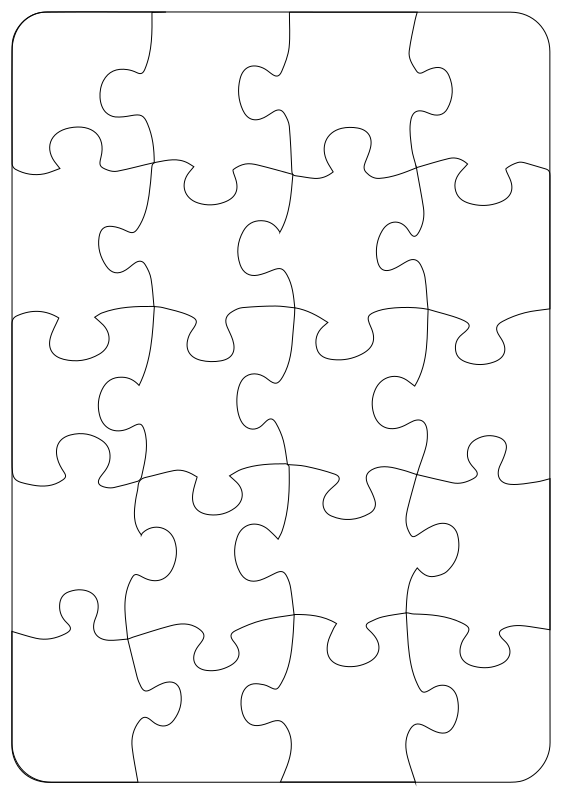

While you can use any material you like as a base for the puzzle, a high-quality base print is the one essential requirement. Many public libraries, print shops, drugstores, and online printing services offer photo-quality printing that works well for this purpose. Depending on your materials and tools, puzzles can be cut by hand with a craft knife, using a desktop craft cutting machine, or with a laser cutter. For the puzzle that we made in-house, we printed the images on photo paper and mounted them onto thin wood before cutting, using a laser cutter for precision. Wood is a solid choice (pun intended), but it is more challenging to cut. Cardboard, chipboard, foam board, or thick cardstock are all viable alternatives!
Printed images can be mounted to your base using any strong adhesive, such as adhesive spray or superglue. We recommend sealing the finished puzzle with a lacquer or clear sealant to improve durability.
Happy puzzling!